

Resurrection – Sarah Das Gupta
Commandments – Kendra Whitfield
Ode to Two Bluejays – West Ambrose
Flow States – Chris Carrel
Ode to Being Proven Wrong – Jade Rothbaum
When He Prompts – Lydia Rae Bush
Drowned in Salvation – Alexandria Lacayo
The Cyclops Mission – Susan Andrelchik
Strong Finish – Spencer Keene
Judith – A.K. Burke
Dancing Queen – Kendra Whitfield
The Pond – Gregory Smith
Decision Made – Samantha Slaven
What Moved Through Me – Sheila E. Murphy
The Brood Emerges – Mackenzie Kae
Flowers in Ruin
Resurrection
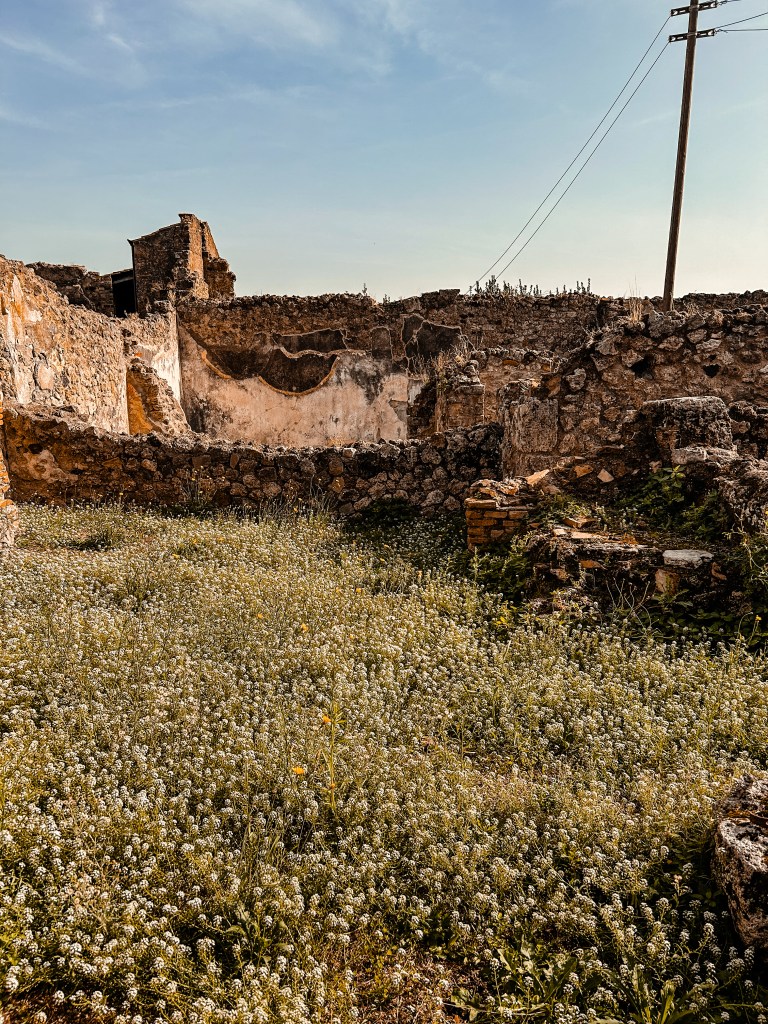
The winter garden is dead. Frost’s cold fingers strangle the last signs of life. Dry, black stems pierce the pale rays of winter sunlight. Brown skeletal leaves of bracken sink into the sodden earth. Summer’s corpse is finally laid out as darkness creeps over the frozen grass.
Slowly, the moment of resurrection approaches; the shattered mirror reforms. A snowdrop
fights its way through the frozen earth. On bare Magnolia branches, tiny buds begin to form.
Ancient apple trees are thinking about living through one more Spring. The intertwining brown stems of the wisteria move in their deep winter sleep. Now the dark yew, which never surrenders, even to winter’s most barbaric assault, is dreaming of its five hundredth summer. The first blossom drifts over the grass. A blackbird sings from a willow bough!
Commandments
-after Cynthia Dewi Oka
Wear bright colours, especially on grey days, but only if you want to. Celebrate
tiny moments – garbage day, finding lost socks, days the cat doesn’t puke.
Let the juicy crunch of fresh lettuce overpower your tongue, let honey
drip down your throat like golden wine. Savour the seasons, do not
wish away the discomforts of the time you have been gifted.
Cherish the gifts of Winter; spring will come. Spend
energy on what nourishes your soul. Seek beauty.
Immerse yourself in creation. Rest exuberantly.
Notice. Dance in the kitchen on Saturday
nights while the pasta boils. Keep
champagne in the fridge. Skip
barefoot through sunpuddles
on green lawns. Allow
sadness. Welcome
it. Grant your
self some
grace.
Ode to Two Bluejays
By West Ambrose
Softly, softly jade Summer leaves
pour from the drenched eaves;
grey-cyan feathers splay on perched branches,
four pair of dramatic eyes, asking
where shall we go next, my most beloved friend?
what to give o’er to Whimsy, what to grandly pretend?
who will we dress up as, who will we two take along?
who will we travel with, as, for— Will we ever belong?
Asking, the rain becomes neon-gilt sun,
asking, the day becomes dual seraphs, silver-tongue’d—
asking the song and asking queer Solitude,
asking the psalm and asking noble Infinitude:
Where shall we go next, when winds change for the season?
Where, asking rhyme-scheme; [w]rite, wrong, or without Poesie’s reason?
Where, with no one to gaze upon us but the glittering stars;
where, but my wings spread in the divine image of yours?
Jade leaves, lofty eaves, smiles hidden in plumes that forever Ascend—
Softly, softly where shall we go next, my beloved friend?
Flow States
By Chris Carrel
Rain spilled itself everywhere without exhaustion. Having traveled thousands of miles from the Tropical Pacific to the West Coast’s cold November, the storm had come intent for the deluge. Far beneath the clouds, Grace Wa lay in the darkened bedroom next to her softly snoring wife. She had been awake for an hour or more, listening to the improvisational music of the wind and rain roaring over Meg’s accompaniment.
Swollen raindrops struck the drumhead of the flat roof like a thousand tiny hands marking the storm’s furious rhythm. Exuberant wind gusts elaborated on the theme while water sang itself in turbulent freshets falling through the gutters and drainpipes and spilling onto the concrete dissipator block below her window.
All is water tonight.
Sleepless nights like these occasionally came to Grace, where her mind would not release her regardless of what she tried – warm herbal tea, meditation, or reading in bed. There was nothing she could do but lie in the dark, listening to her thoughts swimming beneath the ocean of night and waiting for sleep to descend. Any resistance would only pull her further away from slumber.
If she must remain awake, though, the sound of rain offered her a reassuring soundtrack. Fall rainstorms reminded Grace of her childhood growing up on the outskirts of Seattle, not far from where she and Meg now lived.
The weather reports had earlier warned of the impending atmospheric river and two to three days of heavy rain. A “Pineapple Express” they called it, owing to its origin near Hawaii.
At any time, there were three to five of these rivers moving around the planet’s atmosphere, part of this ocean planet’s great water cycle. A single one of these sky rivers could carry more water through the clouds than the Amazon River shipped through its banks. Several times a year, the atmosphere took aim at the Pacific Northwest and brought a righteous flood down on their heads and roofs.
They weren’t exactly normal rains anymore, though. Supercharged in a heated atmosphere, the rains fell harder and longer than the old days, and the resulting flooding and associated damage seemed to grow worse each year. Still, the rain sounded comforting and familiar, and she badly needed a little solace.
When she was a child, her parents did not divorce until things were too far gone. The cost of that was a house where tension and hardness were the atmospheric condition they all soaked in. Then, as now, Grace found that listening to a rainstorm reassured her that the world and its larger intelligences retained a rightness at the core of things. The Earth possessed a power and beauty that offered lessons in humility and renewal for anyone open to learn. The storm’s rhythm and flow were as reassuring to her as a mother’s heartbeat is to the babe suckling at the breast. And as sure as the skies would grow dark and sodden, bright, sunny days always followed the storm.
Though her wife was less than arm’s length away, Meg seemed as distant to her now as her parents had become to each other. Meg and she had grown distant by degrees. So gradually that Grace could daily convince herself that nothing was wrong, or it was just a rough patch, or that they had time to figure it out, until one day she realized those rationalizations were no longer viable, if they ever had been. She didn’t yet know what she was going to do, or what was likely to happen, though the forecast called for heartache and lawyers.
The rain continued drumming itself against the roof while wind gusts sang through the trees, painting pictures in her mind of those great, green wings of cedar and hemlock drawing forward and back as they were pushed about by the wind. The trees here had reigned for millennia before white settlers arrived, and they were long accustomed to the weather. On nights like these, they moved fluidly and easily surrendered small, weak branches to protect the larger body.
For a time, Grace tried to imagine the shape of the atmospheric river flowing miles above her. She pictured a massive trough of clouds saturated with water, evaporated from the warm Pacific, and driven to her by jet stream winds and physics that were beyond her understanding. In her mind’s eye, Grace saw this as a dark blue river barely visible in the night sky, though she doubted the human eye could see this atmospheric beast without the help of some graphic wizardry. In her thinking, it was more than a phenomenon of weather. It was mythical and unknowable.
Nonetheless, she played the storm in her imagination like a movie, painting images to the sounds leaking in from the outside. As the wind whooshed and huffed, she imagined the mighty conifers swaying back and forth like parishioners in a church, their dark shapes outlined by the weak light of the half-moon bleeding through the clouds. Grace tried to visualize the multitude of raindrops that fell in general agreement on everything, covering roofs and roads, and all the grass and trees in its visitation. She wished that she could know more intimately the storm’s great rhythms of wind, and the falling drops of water that, having traveled this far, were already on their way through downspouts, pipes and ditches, seeking passage back to the ocean.
These images soothed her and drew her into a lull. She hadn’t quite drifted off to sleep, though she became aware of gaps opening in her memory, places where her conscious mind had drifted over the line into a brief, sleeplike state and back again. It was like arriving at a destination to find that she had no memory of how she got there. The storm had taken up residence inside her. She had become so attuned to its rhythm that she had washed out a little bit, at least momentarily.
Water brought her back to herself and a sharpened state of wakefulness. She felt something wet on her cheek and when Grace touched a finger there, she found moisture. It wasn’t a lot of water. Not much at all. About what you’d find on the cool surface of a sweating pipe or a small bit of condensation in the corner of a basement window on a wet spring morning.
But it was water. Where was it coming from?
It couldn’t be a leak. She would have felt the splash. She touched the other cheek and found it wet, as well. Raising her hands above her face, she grasped the palm of her left hand and pressed against the skin. Drops of water splashed onto her cheek and chin.
Following the question forward, Grace sat up on the edge of her bed. With her right hand, she felt her gut beneath her light, cotton sleeping shirt. She felt normal, perhaps a bit cold, but solid. Sliding her hand beneath the shirt, she pressed two of her fingers into her abdomen. The fingertips pierced her skin as easily as dipping them in a glass of water. A small trickle of fluid like a warm, tropical rain, leaked from her gut and ran down to her crotch, where it soaked into her pajama pants and underwear.
This should have been alarming, but instead, Grace was intrigued, and excited. She sensed the possibility of something new forming in the atmosphere, a change in the air pressure.
They weren’t logical thoughts that propelled her forward down the hallway in her bare feet and cotton pajamas. She experienced impressions and abstract sensations that triggered her movement, leaving her standing outside the front door, beneath the covered porch while the storm raged just beyond the enclosure. She felt as if she was watching herself from a distance.
At the edge of the porch, the stone walkway disappeared into darkness. The lawn to the left of the porch lay sodden by rain, illuminated dimly by the porch light. The night air was cold, and its winds moaned and growled. The rain striking the roadway beyond the front yard sounded harsh and violent, but something in it called to her musically.
In the midst of all this wetness, a physical desire had begun to burn like a smoldering fire in her groin and guts. The heat of it mushroomed and spread through her body until it took the shape of intent.
Grace walked out from under the covered porch and into the storm. She was immediately drenched by the furious, lashing rain and the wind struck roughly at her, tearing her bindings. Briefly, Grace felt herself coming apart. She splashed to the ground in a million pieces, though without ever losing her sense of unity. She was still Grace, but now she was a multitude of Grace.
Her thoughts existed in each drop like many little radios all receiving the same station and her awareness of self was both local and generalized. She found herself naturally flowing back into a body of water, as drops of her found each other, formed small pools and moved toward their neighbors to reestablish a bodily consensus. As she flowed, she felt the little pebbles and blades of grass pass through her like daydreams.
Grace had never known a freedom so open and unlimited. At once she knew a permeability and mutability that enabled her to flow wherever she wished, to assume the size and quantity that suited her from moment to moment. She had become her own river, her own lake, her own ocean. Drifting to the edge of the property, she poured herself into a grass-lined swale and passed down the edge of the road, intermixed with the other runoff.
She knew from her human experience that the night must be cold, but the water through which she moved felt as warm and comforting as a slept-in bed. She swam to the end of the street and swelled through the stormwater culvert, then turning left, she flowed on alongside another road.
Soon, she heard distant, soggy voices. Though it felt like she heard them in a human sense, through her ears, she had none to hear with. Instead, the sensations arrived through some equivalent perception, a water sense.
She followed the drainage upstream and traveled toward the sounds with swelling excitement. Before long, Grace arrived at the edge of a large, recreational park that lay several blocks from her house. The voices were louder here, and they impressed her as playful and joyous.
There were seven others like her, humans who had found their flow state, and now cavorted in the short grass between the baseball and soccer fields. They were splashing about and rolling into, under, and through each other. In their quick and frisky movements, they reminded her of a group of river otters frolicking along a riverbank. Their long and slippery liquid bodies rolled against and passed through one another with near frictionless ease. Sometimes they joined together and appeared to become one large puddle, but they always split back into their individual selves. They appeared as comfortable in these in-between states as they were in singularity or in unison.
When they noticed her watching from the edge of the field, they greeted her warmly and called for her to join them. Soon, she was chasing after the others and meeting them in pulsing currents of moisture, their motion driven by the wild energy of the storm breaking within each of their bodies of water.
Grace found that she could easily distinguish one from another by reading the particular properties of surface tension, chemistry and electrical charge in their waters. She read their names as more of a flavor than words crafted for sound. The sensation of flowing through another, or being thus swum through herself, came as a wonderful sense of physical transition, of changing, and diluting and reconstituting while never dissipating. In this state, she felt more distinct and alive than she had ever felt before in her body, and the sense of union surpassed any previous sense of belonging. She felt suddenly that she could go anywhere and assume any shape and depth a moment might require.
Above the surging, roiling pond of water faeries, the storm raged, spitting its load of water vapor and roaring like a beast. It sent its lowest winds at them, raking the surface of their waters like fingernails dragged sharply across a naked back. They responded in kind, darting about and rising up in waterspouts as tall as a human, before dashing themselves back into the grassy ground, splashing apart and reforming.
Just before dawn, a lull in the storm settled in above them and without a signal the eight water sprites left each other and returned to their homes and their human forms.
In subsequent months, whenever a nighttime storm blessed them with rain, Grace returned to meet her lovers in the park, where they continued – and expanded upon – their play, wrapping themselves in each other in all manner of combinations, testing the bounds of form and being.
On nights without rain, Grace lies in bed in the darkness, adrift in the dry ruins of her broken marriage, and tests the contours of the wild dream that has opened in the depths of her.
Some night soon, when the rain returns, she will stand naked in front of the house and enter her flow state one final time. She will once again become water and flow towards the park where they meet. Grace will invite any who wish to accompany her and on they will flow together, winding through the culverts and beneath strip malls, following the roads and pipes until the city empties them into the great sea just beyond the shoreline.
From there it’s a short journey to the Pacific Ocean, where the water and sky promise the world.
Ode to Being Proven Wrong
I’m in love with that one
second you realize oh, how gorgeous
that one thought can ripen into another
How one thought can,
beyond the world you thought
you deciphered, one
thought can now belong.
Humans are changeling creatures,
forever trapped in a game of telephone,
huffing and screeching and feeding each other
scraps, sometimes a hairball of
letters, Post-It notes, papers stuffed in bottles,
engraved plaques, business cards, billboards. All
programs on different frequencies—somehow
we’re tuned to each. Choking
on tangles, we still manage to
dream up something new. Maybe
it gets a bit much but you have to
keep tabs on the battle because we never
stop marching in the war between
everything that is and everything
that could be.
When He Prompts
If my emotions have been mangled,
let us not say that they’ve been
disfigured or mutilated.
Let us just call them crushed—
ground into a fine powder
woven throughout my tapestry,
gluing together the pottery
of my seemingly disjointed pieces.
That I may no longer be in a phase
but be an integration—
a disfiguration and mutilation
of what it means to be
damaged. Let us say that I am the
enchantment behind mangled as a word.
I am the enchantment behind all my words.
Drowned in Salvation
With shaky hands and watching eyes, Father fixes his lapel.
St. Cecelia shining through the pane, her song, it echoes now.
Is fifty years, alb and chaste, converting me to an infidel?
A creeping chill climbs up his spine; I curse the angel who fell.
Father speaks of the Trinity, but his mind is somewhere else.
Is fifty years, alb and chaste, converting me to an infidel?
With shaky hands and watching eyes, holy water fills the shell.
As tepid transformation nears, he sees the banks of Jordan.
Does the river’s cleansing virtue prevent the landform’s swell?
Descending droplets stir the babe, who wears a silky gown.
Is fifty years, alb and chaste, converting me to an infidel?
The mother tries to soothe him; is relief within the Crown?
Pairs of parents renounce transgressions to save this soul from hell.
Why the Seven Sacraments? The Epistles never said.
Is fifty years, alb and chaste, converting me to an infidel?
Father lights the candle from the sacred Paschal’s solemn flame.
Speechless now, he stares at the crowd, the lit torch still in grip.
With shaky hands and watching eyes, the House of God ignites.
The fifty years, alb and chaste, converted me to an infidel.
Succulent after Rain
The Cyclops Mission
I always knew bad things can happen to good people. But at sixty-five, the shock of my husband leaving me for a younger woman sent me into a tailspin. After marrying at age twenty-one, I supported my ex through law school. We raised two wonderful children who in turn had each given me a grandchild. I worked years as a teacher, showing up to do the best job educating those darling first graders. I had stayed in shape, still able to run a 10K if I wanted. And this was my payback.
Numbness turned into panic, then into fury. Finally at the end of the year, I looked back on my life with scrutiny that held no sugar-coating. Sure, I had character. Sure, I had a lot to show. Sure, I should be proud. But it was not enough. I weighed up my options as I dealt with an ardent desire to give myself joy. I could not stomach the idea of hunting for another man. I could not stomach the idea that I should travel and hence feel fulfilled. I could not stomach spending hours over glasses of wine with girlfriends as we commiserate.
I needed joy, pure joy, and nothing else. And I wanted to become famous. My humble past was now haunting me, and I deserved credit before my time on earth was over. Not Lorena Bobbit famous or Betty Broderick famous, although those thoughts were tempting, but recognition that lasted beyond fifteen minutes.
Driving on the freeway through downtown Atlanta on the way to see my therapist, I glimpsed the ubiquitous Cyclops graffiti character. His domed shape sported his eye dead center as usual. This little guy had a red hat. Of course, I was not the only one in the world who wondered how graffiti artists/taggers accomplished the impressive placements of their artwork, but I had often given them unspoken credit for what they did. The mini-Banksies of the world. After all, they were brave and unabashed–the way males seemed, in general, to be able to live their lives. The assumption was that urban artists were all male.
In the car at that moment, I decided I would join the ranks of taggers and put my art minor to use.
In my schoolmarm-like organized way, I drove around town hunting for the Cyclops. I found three of them that looked reachable by foot. I took notes. I found places to park my car, ways to come face-to-face with the one-eyed masterpieces. I thought of the best hours. I chose the best weather. I purchased my materials and clothing. I practiced my images in the garage, doors closed, with cans of spray paint. The fumes were intoxicating, as intoxicating as my newfound plan.
It was a start, and I was excited. Even joyful.
Right off the 17th Street bridge, I planned to reach the Cyclops image by scooting on my butt down a grassy hillside. I had no fear of getting hurt, only of getting caught. I thought about what a young male vandal might do. Well, for starters, wear gloves and throw away the paint can if pursued.
At three in the morning in late March, I parked my car on Spring Street. I had two cans of paint along with a burner phone in my pocket. I walked one block to the hillside that led to the pillar with the Cyclops. My new hiking boots had deep treads for a solid grip and sturdy ankle support. I lowered myself down on the ground to a seated position and slid until I saw the eye staring back. When done, I turned on a mini flashlight. I took a picture with the burner. Cyclops now had a mouth with full fuchsia lips and a pink rose on his hat. My choice of colors complimented the original palette of red and black. A feminine marking by a female urban artist.
In the morning, I transferred the picture to my own device and drove to a Starbucks where I threw away the burner. Over my latte, I smiled at the image and planned my next color scheme.
The second Cyclops on my list was in a more open territory, under an overpass near the Chamblee-Tucker exit. Stopping on the freeway would be impossible, so I planned to park my car on a frontage road. To get to the pillar I would have to climb a fence. This particular Cyclops screamed lime green with yellow accents. I would go in with orange for the lips and golden rod for a sunflower.
Once again, I parked my car around three in the morning. This time it was late April. The fence was higher than I had thought. I threw my supplies over the other side along with my jacket. The toe of my right boot got stuck in the chain link, so I let myself back down and went back to the car to change into an old pair of running shoes. When I made it over the fence, I retrieved my jacket and paint cans and went to work. Click. I snapped the image and went home. I chose a different coffee house to ditch the burner. The sunflower was a replica of Van Gogh’s itself. I felt alive.
The third tagging required a little more planning. It sat dead center on an overpass in mid-town. It took two trips to scout how to gain access to the side of the overpass. It had a narrow ledge with a rail attached to the vertical surface where the blue Cyclops looked out over the freeway. The ledge spoke to me. This is a walking bridge, come along now. The rail looked waist-high. I would not know for sure until I stepped onto the ledge, but I was hopeful. I planned to paint purple lips and a sprig of lilac to top the hat. I would go with a metallic this time. I knew I needed to do this one before the summer heat and humidity discouraged me.
I parked my car. I walked to the section of the overpass where I climbed down. My estimation was right. The rail on the ledge hit my waist, and I felt secure. I crouched down as I made my way to the Cyclops. I did not want a do-gooder to think they had spotted a jumper as they drove underneath the overpass. The lilac turned out exquisite. This time I used a third can of paint. It was lime green and I added leaves to frame the flowers. Ready to take my picture, I was up so close the difficulty of getting a good perspective stumped me. Plus, I had to wait to shine my light when there was a gap in traffic.
“Got it!” I said aloud, feeling relieved.
I left the three cans of paint and squatted down to start the crawl back. In the distance, I saw a dark figure walking towards me. I stopped. I thought about turning around and scurrying in the opposite direction but then the person started to jog. A man dressed in black reached me while I still crouched.
“What do you think you are doing? Did you just paint on my Cyclops? Who the hell do you think you are?” the figure yelled.
I stood up. It made me feel less threatened. I cleared my throat.
The figure said, “What the hell? You’re a woman?”
“Well, uh, yes I am.” My heart was beating in my chest.
“Well knock it off. Those are my works, and you have no right to change them. Go make your own images.” Then he looked down. “Someone slowed down. Come on, Let’s get out of here.” He trotted the way he had come, and I followed.
Back on the street he waited for me.
“Oh my God! You are an old woman! Why are you doing this?”
I turned toward my car. I was not going to dignify the question with an answer. He followed me. I picked up the pace and then yelled back, “You know why! For the same reason you do it. I need a thrill. I need not to be me right now. Just leave me alone.” And with that I started to cry. Being alone on a dark street in the middle of the night with an angry man had something to do with it. And I wondered if I sounded pitiful. I did not want to sound pitiful.
The man caught up to me and walked for a few steps. I did not know if I should head to my car or not. I took a deep breath and stopped.
“I’m sorry. I should have been more original. I just didn’t know where to start, so, I picked places where I could reach.”
“Well, you have talent, that’s for sure. And the local media are giving the Cyclops more attention again. Thanks to you.” I stared at him. He continued.
“Look lady, you seem nice enough. If you want to paint with me some night, I’ll show you my tricks. I have a new spot I’m considering. I’ll do a side-by-side piece with you. Give me a call.” He grabbed my right hand and wrote his number on the palm of my hand. Then he bolted in the other direction.
In the morning, I transferred the purple image to my phone. I put the burner into the cat litter bag and in the trashcan by the garage. I entered the tagger’s number in my contacts as “Cyclops.” I texted him another apology and thanked him for his offer. Then I sent him three snapshots of the work hanging in my garage. He acknowledged with exclamation points and one comment about painting the black outlines narrower.
My mentorship had begun.
Bloom
Strong Finish
Too proud to call it
a mid-life crisis,
I gently re-frame:
a mid-life revival.
Unshrunk by the
lithe grey thread
behind my ear:
I am emboldened.
Inviting the speed
of the steepening hill
stretching ahead:
I bend to its curve.
Listen to the echo
of my voice in the
long dim tunnel:
it rings with eternity.
Judith
By A.K. Burke
I was not born a warrior—
no drive or fight in my infant mind.
Birthed by a mother fiercer than any gods,
made powerful through years of strife.
She herself, not born a warrior,
nor her mother before;
perhaps it’s something in our blood that
makes this lineage of women fight,
that gave us passion and thorns.
For how else could I become
this woman of the blade?
With tongue of daggers
and heart of poison,
I still mourn the girl I used to be.
But I am drawn to a divine purpose,
one built upon heartache and scorn and pain.
So, I am now this reluctant warrior,
sword in hand,
bloodline always a step behind.
Wielding my tools of might,
executing the enemy in my way—
how weak he was before he was slain,
taken by surprise,
not seeing the warrior within the woman;
foolish to underestimate anyone
that you allow in your tent.
The warrior’s heart is a heavy burden,
more so than the bloody head in my basket.
But what else could be done,
how could I avoid this path,
when my people have been plagued
by cruelty and violence and savagery?
The job of such women is never done
however hard we fight;
for once we slay the symbol of sin—
much like a hydra—a new evil
grows back and takes its place.
Borne now the title messiah,
but I was meant to remain a girl—
the world, however, is full of such villainy
that I know I’ll always
have to take up my blade again.
And when the time comes—
when I may no longer wield this sword—
next I’ll be forced to pass it on
to my own innocent daughter.
Then she will harbor the weight
of a warrior’s heart
whether she asks for it or not.
Dancing Queen
“We’re fools whether we dance or not, so we might as well dance” Japanese proverb
In your new life, your wings won’t
beat to a rhythm you know.
You’ll have to learn to dance all over again
To music you’ve never heard before.
It’s exciting until the mirrored floor
slips from beneath your feet and you find
yourself dancing on starlight
suspended only by the strength of
convictions you forgot you even held.
The disco ball flashes shattered
light to the corners where once you lurked,
ashamed for wanting to dance,
too shy to take to the floor alone.
Flashing shards of echoed light
sear eyes luminous with regret
for all the missing years
The beat doesn’t care .
Neither – suddenly – do you.
Twirl, twerk, grind, gyrate.
No one cares but you
And you’re the only one who matters.
The Pond
Frank was a real Renaissance man. He was a writer, an artist, and musician. He adored nature and animals more than people. Don’t get me wrong- Frank was a sociable guy. But like many tortured artistic souls, he was happiest in solitude. He never married and only tolerated children when he had to, such as nieces and nephews, and that was limited to holidays. He was always perfectly content staying at home, sitting beside his backyard pond, reading the newspaper, listening to the peaceful sounds of bullfrogs all around him.
His most cherished moments were spent communing with nature: walking in the woods behind his house; eyes closed in his favorite rocker on his back-porch, captivated by the sounds of the night: the neighborhood hooting owl, the chirping crickets, and the cawing crows.
Thunderstorms were always special to Frank, in an odd, macabre sort of way. He loved the smell of rain, the way the entire sky flashed, the rumble in the distance inching closer and closer, the powerful, cloudburst of wind and rain, blowing sheets of pelting drops on the trees; and the clean scent after the storm had passed- a brand spanking, squeaky clean world.
Frank loved frogs. In fact, he was fond of most reptiles and amphibians, but especially frogs. The sound of a croaking frog in his pond soothed to his soul. He waited every summer for the local tree frogs to travel from the woods to his pond. To Frank, summer wasn’t summer without frogs in his pond. Forget the flickering lightning bugs and a festive Fourth of July; forget noisy fireworks and juicy watermelon; forget good, old Baseball and patriotic parades. Frogs meant summertime.
I got to know Frank well after I married his sister Janet. He and I had a good relationship. I respected his vast knowledge of nature and admired his passion for animals. I think he liked me because I liked him.
One summer day Frank stopped by to help us replant our beautiful azalea bushes which were damaged by a vicious thunderstorm. He was sitting in our living room next to the front screen door, relaxing in a rocking chair, cooling off with a glass of iced tea after his extraordinary landscape rescue.
“I believe that everything that dies will come to life again,” he said in classic Frank philosophical mode. “Your azalea bushes should be fine for next spring.”
Then, without warning, he snapped his fingers and blurted out “What you need is a pond!”
Janet loved the idea. I did too but I was worried. The front yard was spacious but not huge. I had cultivated the lawn, getting rid of the crabgrass. The front lawn was a beautiful masterpiece to behold now. I tried to picture a sparkling pond on the lawn but all I kept thinking about was that first shovel of grass and dirt.
In the end, with gentle prodding, I reluctantly agreed.
That first shovel in the lawn was like a dagger through my heart. The empty hole left an empty feeling in my soul. With all the rain we had had it was easy, like a spoon dipping into chocolate pudding. By the end of the day the digging was done, and we were ready for phase two of the project.
Frank was a professional when it came to creating ponds and rock gardens. He had constructed or supervised the building of several ponds in his lifetime. I trusted that the randomly scattered tools, soil, and tarp would soon be replaced by the pond of our dreams.
Frank was very careful, placing each stone and each river jack rock. He ventured to a local quarry to select each stone personally. Like a giant jigsaw puzzle, he arranged and rearranged until the rock garden was perfect. Watching Frank work was like imagining how Michaelangelo did it in his prime.
Then came the moment of truth- trying out the pond for the first time. That initial gush of water was like waiting for Old Faithful to erupt. Bubbling, clear water cascaded playfully down the rocks. I was in love!
Frank picked out the appropriate summer flowers to ring around the circular pond: an assortment of colorful marigolds, planted in a bright mixture of yellow and orange. He sprinkled in a few brown-eyed Susan’s, several pink and purple petunias, and various shades of red snapdragons.
The final piece was the beautiful, two-foot-tall St. Francis statue standing at the high end of the pond. Frank was always partial to St. Francis of Assisi; not only was he named after the saint, but St. Francis was also the patron saint of animals, a subject near and dear to Frank’s heart.
People walked by and stopped to admire the pond. Total strangers and familiar neighbors left compliments. Cars drove slowly by our place, admiring the beauty. The pond blended in beautifully with the rest of the yard.
Frank sure knew what he was doing. My tune had changed. I loved the pond and couldn’t imagine the yard without it.
The wildlife loved the pond. No matter the time of day, we would always find a beautiful creature drinking or bathing in the water. The birds, squirrels, and rabbits sure would miss it during the long winter ahead.
How ironic that, as the pond area went brown and lifeless for the winter, Frank died very unexpectedly after the new year. No one knew he had terminal cancer. He never let on. But that was Frank -very private, right to the end.
“Damn Frank!” wept Janet. “You were my brother. Why didn’t you at least tell me? I never had a chance to say goodbye.”
All the time that Frank had been working on our pond he had been sick. Our pond would be the last one he would ever build. The pond would serve as an everlasting monument to Frank. His spirit would live on through the flowing waters.
The weather was unseasonably warm the following March. I always loved spring – a time for renewal and hope. Soon the daffodils, lilacs, and forsythia were blooming and by Easter, the dogwood tree blossomed, and our world went from a gloomy, dingy brown to spring greens and vibrant colors.
I was planting spring flowers around the pond, yellow and orange marigolds, as Frank had suggested, when I noticed a tadpole sunning himself on one of the stones, its head barely peeking out from underneath the water. It stared at me as I stared at it. Who would blink first?
“We have a guest,” I informed Janet. “A frog is living in our pond.”
“How sweet!” she remarked. “Frank would be pleased. He always loved frogs.”
Then the strangest thing happened. Janet noticed it first. One lovely day, she was looking out at the screen door, sipping her morning coffee, when she saw a robin with a broken wing hobble to the edge of the rocks, leaping into the pond. The bird bathed and splashed carefree. Then, remarkably, the robin flew away, its wing healed.
That was just the beginning. More animals arrived at the pond, bathing, shaking themselves dry on the rocks. An alley cat with a limp dipped its paw in the water, limping no more; a rabbit with a severe scratch on the ear immersed itself and was made whole again; a furry squirrel with an injured tail splashed and played, finally pain-free.
All were instantly and completely healed after bathing in the water.
We began to take notice as more and more creatures lined up for their turn in the pond. It was like the animals had told their friends, who then told their friends. Birds flew in from all directions. We watched them, amazed as all of them left without affliction.
It wasn’t unusual for neighbors to walk their dogs early in the morning or in the cool of the evening. One day our neighbor Elaine was walking her bulldog, Rocky. What was different was Rocky’s sudden desire to check out the pond. He never cared about it or noticed it before; now, suddenly, he cared.
Watching the rather hefty dog dive into the smallish pond, dousing himself among the pond plants and river jack, was comical. Rocky dipped his great brown head under the water. I didn’t blame him for cooling off on such a humid afternoon. Have at it, big guy, I thought.
Several days later Elaine knocked on our screen door. She was always a cheerful, bubbly woman, but she seemed extra exuberant this evening. She took Rocky for his routine check-up earlier in the day. The vet was following a cataract in the dog’s right eye. As of that day, the cataract was gone.
Elaine was the first one to make the connection between the pond and Rocky’s healing. I was happy for Rocky, but I asked if we could keep this good news to ourselves. I just didn’t want news to get out and suddenly our front yard would become an animal shrine, a doggy and kitty version of Lourdes.
She agreed. But then Janet got a call from another neighbor around the block. She had a parrot with a cracked beak. Could she bring Polly to the pond?
There were no prayers, no burning candles, no processions. The neighbor simply asked Polly to sit on her finger while the owner knelt beside the pond and splashed a handful of water on the bird. Miraculously the beak was healed before our eyes.
The owner screamed with joy, wailing “Polly, oh Polly!” while incessantly thanking us.
Janet and I conferred at the kitchen table. We weren’t going to promote the fact that we, somehow, someway, had a healing pond in front of our house. But we weren’t going to deny it, either. This magical water could help so many sick creatures. We were animal lovers too. We owned a cute terrier dog named Katie. I could only imagine how it felt to have a sick furry friend- the sadness, the financial burden, the stress- and then, one bath in our pond and -a miracle!
Was St. Francis somehow involved? Was his spirit blessing our pond? Whatever it was, supernatural events were occurring. We were blessed to have this phenomenon occur in front of our house, but I also had to admit it was kind of spooky too.
It was always fun to see how Freddie the Frog reacted to visitors using his pond. “Freddie” is what we named the visitor who still hung out, usually sunning on the stones or swimming underneath the surface. Freddie got out of the way when a bigger animal, like a Rocky, invaded his space. But he never left the pond area, so we figured he was happy sharing his domain with needy creatures.
Along with listening to baseball on the radio, a new summertime activity played out before my eyes: I sat on the front porch in a lawn chair, a glass of iced tea handy, while watching the wildlife take turns in our pond. Perhaps the most impressive sight that summer was the unexpected arrival of a bald eagle, swooping above majestically, gradually and gracefully landing beside the pond. Out of respect, all creatures stepped aside as the regal bird splashed in the pond for a few moments, basking in the sun, drying on the rocks before taking off, gliding and soaring high into the sapphire sky until flying out of sight.
One morning the local newspaper came out to do a story and take a few pictures. Our pond was even featured in the Philadelphia newspapers, and television cameras started filming the front yard. Our place had become a local must-see destination.
That’s when the floodgates opened.
It seemed as if every sick or injured animal and its owner living in the Philadelphia area had descended on our street. We soon thought that maybe we should start scheduling appointments, that’s how crazy it was getting. But, despite the circus atmosphere and the traffic on the street- the neighbors weren’t too crazy about that- all the animals were incredibly healed. No matter the affliction, the ailment, or the condition.
Before long, desperate people began bringing their sick children. It broke our hearts, especially when they were not cured. Only the animals were healed.
It wasn’t long before geologists, chemists, and veterinarians stopped by to test the water, the rocks, the earth, anything that could’ve attributed to miracles without supernatural intervention. Despite all the calculations and examinations, they could find nothing scientifically unusual happening on our property.
The only explanation remaining was God.
The days melted away and soon it was October 4th, which happened to be the Feast Day of St. Francis of Assisi. It was on this day of all days that our miracle pond dried up. Not literally- the water still flowed for another month before we closed for the upcoming winter- but after early October, despite the pond brimming with fresh water, no animal was cured. The miracles abruptly ended.
The geese started flying south, and many of our neighborhood birds had already started their journey to warmer climates. Other creatures began hibernating. The flowers dried up, even the fall mums eventually died. It was sad to see the pond so brown and lifeless, especially after such an active and miraculous summer.
December and Christmas came and went. We got our usual amount of snow that winter, which was great for the lawn. We looked forward to spring, when we could open the pond again, but we wondered if miracles would resume come March or April. Meanwhile, we continued to schedule appointments, months ahead of time.
“Tell Whiskers to hang in there,” Janet advised one woman. “Help is on the way.”
Spring arrived late that season, and our pond didn’t re-open until Easter Sunday, April 20th. Our crocuses were out, as were our tulips and daisies. The clean air was scented with green grass and soft breezes. The pond opened but the miracles did not resume. It was just a regular pond. The healthy neighborhood birds, squirrels, and rabbits still visited every day, taking their daily baths. Soon the calls dwindled; we advised people to be aware, especially if they lived at a distance, that they would be taking a chance to visit us because the miracles were hit-and-miss now. In a way, it was nice to be back to normal once again.
Once the weather got a bit warmer and the humidity returned, our little friend Freddy reappeared in the pond, making the trek from the nearby ravine. Hibernation was over for another winter. I was fixing a leak in the waterfall when I noticed him. He seemed to know me because when I spied him peering over the rim of a rock I said, “Happy Spring, Freddy!” and he responded with a resounding “croak!”
Unbeknownst to Freddie and the other pond dwellers, we had made the decision to keep the pond open year-round from then on. The winter birds, the squirrels, and other wildlife that did not hibernate missed the water too much. We installed a heater in the pond to protect our blessed water from freezing over the long winter. Now Freddie would be able to hibernate in the muddy bottom of the pond, rather than make the annual long journey to the ravine.
Later that spring, our dog Katie became severely ill with an unshakable stomach bug. Medication wasn’t working and she started to lose weight. It was then we took her to the vet, and they diagnosed her with a very rare canine cancer, for which we were told there was no cure.
We brought Katie home to die.
I filled a small bottle with our pond water and encouraged Katie to drink it. Then I rubbed a little on her belly. Funny how I was so used to miracles happening. Supernatural events had been so commonplace before. Now, when nothing special happened to Katie, when she remained so deathly ill, when we prayed for a miracle, nothing happened.
It was Janet who figured it out.
Janet held Katie in her arms and walked her outside one evening. I followed, unsure what was happening. Twinkling stars were fading quietly with the increasingly overcast sky. A rumble in the distance signaled a thunderstorm was on its way. A gusty breeze grew stronger; flashes of lightning lit up the ominous sky.
Janet knelt beside the pond and dunked the little dog into the water. Immediately, Katie shivered, reacting to the chilly water. Then she squirmed with life, licking Janet on the cheek and snuggling her neck.
Our Katie was back to life.
Janet, with tears flowing down her face, cried out joyously, “Thank you, FRANK!” A cloudburst soaked us with cooling rain.
Her gratitude was acknowledged by one simple “croak” from somewhere in the pond.
Decision Made
The truth is revealed
In a quiet room
Under isolated lights
The sound of traffic filtering through the open window
My thoughts
Ripping my brain apart
Surgery without anesthetic
Blazing pain
Like a vapor
Reaching out beyond my ears
Tries to wrap around my throat
Choke me
Take all my oxygen and toss it away
My conscious mind
Intervenes
I know better
Know you well
A mirage
Pure trickery
You are nothing
The aches are temporary
I am the only one standing in my way
I can walk through the barrier
Leap the tall buildings
I have nothing to prove
To anyone
It’s a process
It will take time
But, sweetheart
I got all day
What Moved Through Me
What moved through me winced invisibly.
A royal jelly flower. May we
be nudged up the trellis to become
the daily toil of a garden enclosed.
I am still the child I could not early be.
If innocence means rinsed by some vagrant god,
then I stay pure in earned adulthood.
Are you in tune with the sour cherries
hanging heavy in the shorter tree?
How might your practiced hunger cherish me?
I learn to reach the clouded-over moon.
Always the noonday sun holds still within.
My hands empty themselves. The plucked guitar
with leisure paints a not-canary hue.
But there is singing from the respite stars.
As though a gathering of doors.
A pond, a baptismal font to bless
myself. A road leans where the road goes.
I rest my eyes at midnight knowing
darkness comes. Loads its silver on my thumbs.
I watch for lights that might guide my ride
into some nether storyline.
A line of knit lace sheltering my arms.
The Brood Emerges
the world flips wrongside up
so i lay flat like giving birth
press the earth with my soles
and push to the edge.
hair swinging like freedom
over a cliff i count ripples
as pebbles launch into the river
a million baptisms sans preachers.
cicadas know the rhythm of
revival tent poles being pounded
to gospel and prophecies and
once in a century earthquakes.
a million cicada shells launch
into the river and i birth prayers
with my soles as i swing rightside
and push myself to follow them down.
Butterfly on a Sunflower

 Skeleton Flowers Press